


How to Wash Graphic Tees Without Fading in 2026
Table of Contents
- Why Graphic Tees Fade: Heat, Friction, and Detergent Residue
- Step-by-Step: How to Wash Graphic Tees Without Fading
- The Best Laundry Detergent for Graphic Tees
- Preventing Graphic Tee Cracking: What Actually Works
- Air Drying Graphic Tees vs. Machine Drying
- Removing Stains and Restoring Faded or Cracked Prints
- Conclusion
- Frequently Asked Questions
Last Updated: September 30, 2026
Why Graphic Tees Fade: Heat, Friction, and Detergent Residue
The print on a graphic tee fades because of three things: heat, friction, and leftover detergent. At Badger Call Design, we print patriotic tees for veterans, first responders, and families who wear them hard. So we care a lot about how to wash graphic tees without fading.
Here is the short answer. Graphic tee care is the practice of protecting the printed ink layer on a decorated shirt by controlling wash temperature, mechanical action, and drying method. Get those three right, and your prints stay sharp for years.
Most people blame cheap ink. That is usually wrong. The damage comes from the wash cycle, not the design.
How Heat Damages Screen-Printed Graphics
Heat is the number one killer of screen-printed graphics. Hot water softens the cured ink and weakens the bond to the fabric fibers.
Once that bond loosens, the print starts to crack and peel. The American Cleaning Institute's laundry guidance notes that high wash temperatures speed up wear on decorated garments.
Warm and hot washes also shrink cotton. Shrinkage pulls the fabric away from the ink, which makes cracking worse.
The Role of Agitation and Fabric Fibers
Agitation is the second problem. Every spin cycle rubs the print against other clothes.
That friction wears down the ink surface, and you start to see fading and dull spots.
Step-by-Step: How to Wash Graphic Tees Without Fading
Follow these steps and the print will outlast the shirt. The whole process adds maybe two minutes to your laundry routine.
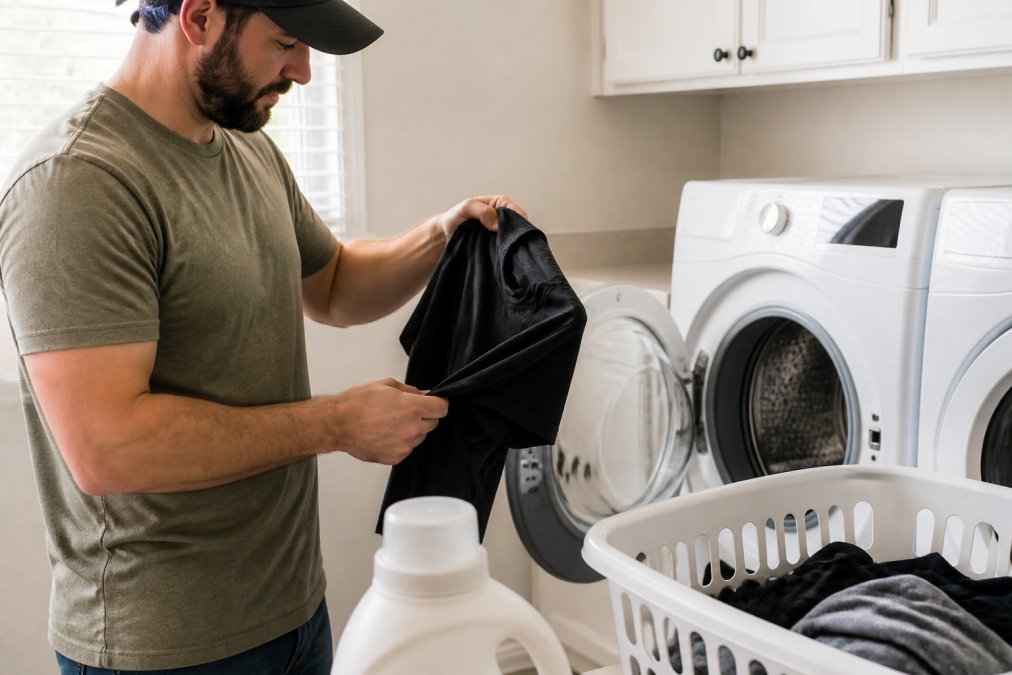
Turn Shirts Inside Out and Sort by Color
- Turn each shirt inside out. This puts the print against itself, not against other clothes.
- Sort by color. Keep darks, lights, and whites in separate piles.
- Sort by fabric weight. Wash tees apart from jeans, towels, and anything with hardware.
- Close zippers and empty pockets before the load starts.
- Skip fabric softener. It leaves a waxy film that traps detergent residue.
Choose Cold Water and a Delicate Cycle
- Set the machine to cold water. Cold keeps the ink bond intact.
- Choose a gentle or delicate cycle with a low spin speed.
- Use a mild, bleach-free detergent and measure it, don't guess.
- Wash on a short cycle. Your shirts are not that dirty.
- Remove the load right away to avoid mildew and set-in wrinkles.
That is the entire method. Cold water, gentle cycle, inside out, and out fast.
The Best Laundry Detergent for Graphic Tees
The best laundry detergent for graphic tees is a mild, liquid, bleach-free formula with no added softeners, brighteners, or enzymes. That is the short answer. The longer answer is about chemistry, and it is the part most guides skip entirely.
The Ingredients That Attack Prints
- Proteolytic enzymes. These break down protein-based stains, but they can also degrade the plasticizer in plastisol over repeated washes, leaving the print chalky and dull. Look for "enzyme-free" or "for delicates" on the label.
- Optical brighteners. These fluorescent dyes deposit on fabric to make whites look brighter. On a dark or colored tee, they leave a bluish haze that reads as fading. They also build up on the ink surface.
- Chlorine bleach and oxygen boosters. Both strip dye from the fabric and degrade the ink film. Even "color-safe" oxygen boosters accelerate fading on dark prints over time.
- Cationic surfactants (fabric softeners). These carry a positive charge that bonds to fabric fibers and leaves a waxy residue. That residue coats the print, traps soil, and dulls colors.
- High-pH formulas. Alkaline detergents (common in heavy-duty powders) can swell cotton fibers and stress the ink-to-fabric bond.
What to Look For on the Label
- "Free and clear" or fragrance-free
- Enzyme-free or formulated for delicates
- Liquid instead of powder (powders can leave grit that abrades the print)
- No bleach, no "oxy" boosters, no optical brighteners
- Neutral pH where listed
Use less than you think you need. Extra soap does not rinse out, and detergent residue is a leading cause of dull, faded prints. A common pattern is that a quarter of the recommended capful is plenty for a small load of tees.
A Note on "Gentle" and "Delicate" Formulas
Many detergents labeled "gentle" are simply dye-free and fragrance-free versions of the same formula. That is fine, but it does not mean they are enzyme-free. Read the ingredient list, not just the front of the bottle. If the label lists "protease," "amylase," or "lipase," it contains enzymes.
Preventing Graphic Tee Cracking: What Actually Works
Preventing graphic tee cracking comes down to three habits: cold water, low heat, and no direct iron contact on the print.
- Wash inside out every single time
- Never let a hot dryer finish the job
- Avoid stretching the shirt while it is wet
- Do not iron directly over the graphic
- Fold instead of hanging heavy prints
Air Drying Graphic Tees vs. Machine Drying
Air drying graphic tees is the single best way to protect the print. Heat damage in the dryer is what causes most cracking and peeling. But how you air dry matters just as much as whether you do.
What Heat Actually Does to the Ink
Plastisol ink is a plasticizer, it is designed to be flexible, but heat makes it soft and pliable. In a hot dryer, the ink film softens, the fabric underneath shrinks (cotton can shrink 3-5% on a hot cycle), and the ink is forced to stretch or crack as the fabric pulls away. Once the ink splits, it does not re-fuse.
Air Dry vs. Machine Dry: A Real Comparison
| Method | Heat Level | Mechanical Action | Effect on Print | Best For |
|---|---|---|---|---|
| Air dry flat on a rack | None | None | Minimal fading, no distortion | Everyday tees, heavy prints |
| Air dry on a hanger | None | Gravity stress on shoulders | Neckline stretch, print distortion | Light shirts, quick touch-ups |
| Tumble dry low | Low | Moderate tumbling | Slow wear, gradual dulling | When you're in a hurry |
| Tumble dry high | High | Heavy tumbling | Fast cracking and peeling | Never use on prints |
Drying Rack vs. Hanger: The Structural Difference
A drying rack beats a hanger for heavy prints, and the reason is physics. When you hang a wet tee by the shoulders, the weight of the water, which can add a pound or more to the garment, pulls downward on the neckline and shoulder seams. Over time, that stretches the collar and distorts the shape of the shirt. If the shirt has a large front print, the weight of the wet fabric also pulls on the ink film, which can stress the bond between ink and fabric.
How to Air Dry Without Wrinkles
Air drying can leave shirts stiff or wrinkled if you skip a step. Here is the fix:
- Pull the shirt from the washer immediately. Leaving it in the drum creates set-in wrinkles.
- Give it a hard snap. Hold the shirt by the shoulders and snap it once or twice. This smooths the fabric and releases tension.
- Lay it flat on the rack. Smooth the print with your hand, but do not stretch it.
- Keep it out of direct sun. UV light fades both the ink and the fabric. Shade or indoor drying is best.
- Flip it once. After a few hours, flip the shirt so the back dries as evenly as the front.
Removing Stains and Restoring Faded or Cracked Prints
Treat stains from the inside out. Place a clean towel under the stain, then blot from the back with a mild detergent and cold water.
Conclusion
Heat, friction, and detergent residue are what fade a graphic tee, and all three are easy to control. Wash inside out, use cold water and a delicate cycle, skip bleach, and air dry whenever you can.
Frequently Asked Questions
Are you supposed to wash graphic tees inside out?
Yes. Turning graphic tees inside out before washing protects the printed design from friction against other garments and the washing machine drum. This simple step reduces cracking, peeling, and fading by keeping the graphic away from direct agitation. It also limits exposure to detergent residue that can dull colors over time. Pair inside-out washing with cold water and a gentle cycle for the best results.
Does hot water ruin graphic tees?
Hot water accelerates fading and breaks down the bond between the ink and the fabric fibers. Over time, heat damage causes prints to crack and peel. Always use cold water when washing graphic tees. Cold water cleans effectively while preserving the screen-printed design and helping the shirt hold its color longer. If a stain needs extra attention, pre-treat it rather than raising the wash temperature.
Is OxiClean safe for graphic tees?
OxiClean and similar oxygen-based stain removers are generally safe for graphic tees when used as a pre-treatment rather than a full-wash additive. Apply a small amount directly to the stain, let it sit for a few minutes, then wash in cold water on a delicate cycle. Avoid chlorine bleach entirely, as it breaks down fabric fibers and strips color from both the shirt and the print.
Can I put graphic tees in the dryer?
You can, but only on the lowest heat setting, and air drying is always better for print longevity. High heat is the leading cause of cracking and fading in screen-printed designs. If you must use a dryer, choose tumble dry low and remove the shirt while it is still slightly damp. Air drying graphic tees on a rack or hanger eliminates heat exposure and keeps prints looking new far longer.