


Do Graphic Tees Fade Quickly? Here's What Actually Happens
Last Updated: November 1, 2026
Quick Summary
Yes, graphic tees can fade fast if you wash and dry them like plain cotton. The print takes the damage, not the shirt. Hot water, a hot dryer, and bleach do most of it, so cold water, inside out, and air drying slow the fade considerably.
- Hot water opens the fibers and lets dye and ink lift out.
- Wash graphic tees inside out, on cold, using the gentle cycle.
- Skip bleach entirely, since it eats dye and breaks down ink.
- Air dry, or use low heat only, because hot dryers crack prints and bake off color.
- Identify the print type first, since vinyl needs the most caution.
Table of Contents
- Why Graphic Tees Fade and Crack in the First Place
- Figure Out What Kind of Print You Have
- How to Wash Graphic Tees Without Fading
- How to Dry Graphic Tees Without Damaging the Print
- Why T-Shirt Prints Crack or Peel
- What to Do With a Tee That Has Already Faded or Peeled
- Set Your Wash Routine and Expect Realistic Wear
- Frequently Asked Questions
Why Graphic Tees Fade and Crack in the First Place
Short answer: yes, graphic tees can fade fast if you treat them like plain cotton. The print is the weak point, not the shirt. Ink sits on top of the fabric, and every wash and dry cycle works on it.
Here's what does the damage:
- Hot water opens up the fibers and lets dye and ink lift out
- Agitation rubs the print against other clothes and the drum
- High dryer heat bakes the ink and makes it brittle
Dark tees take the worst of it. Black dye fades to gray quicker than most people expect, and the print around it shows the wear.
Figure Out What Kind of Print You Have
Before you wash anything, figure out what kind of print you're dealing with. Most fading and cracking advice online treats every graphic tee the same. That's wrong. A screen print and a vinyl heat transfer don't fail the same way, and they don't need the same care.
Here's how to tell them apart by feel and look, and what each one needs.
Screen Print
- How to spot it: The ink sits on top of the fabric. Run your thumb across it, you'll feel a raised layer, sometimes a little stiff or rubbery. On older or cheaper prints you may see a fine mesh texture or tiny dots at the edges of the design.
- How it fails: The ink layer cracks along fold lines and fades where it rubs. Plastisol ink, the most common screen-print ink, is durable but brittle when cold and soft when hot, so heat cycling is what kills it.
- Care that matters: Cold water, inside out, gentle cycle. Air dry or low heat. Screen prints are the most forgiving of the three, but they still don't belong in a hot dryer.
Direct-to-Garment (DTG)
- How to spot it: The print feels soft, almost like part of the shirt. On dark garments you'll often see a white underbase layer under the color, which can feel slightly thicker than the color on top. Fine detail and photo-style gradients are a giveaway.
- How it fails: DTG ink soaks into the fibers, so it fades gradually rather than cracking. Heat and harsh detergent are the main enemies. White underbases on dark shirts are the first thing to go yellow or gray.
- Care that matters: Cold water, mild detergent, no bleach, air dry. Skip fabric softener, it coats the fibers and dulls the print faster than people realize.
Heat Transfer / Vinyl
- How to spot it: A plastic-looking layer sitting on top of the fabric. It feels slick and slightly raised, and the edges are usually sharp. Peeling at a corner is the classic tell.
- How it fails: Heat softens the adhesive, and the vinyl lifts. Cracking starts at fold lines and spread from there. This is the print type most likely to peel after a handful of hot washes.
- Care that matters: Cold water only, inside out, gentle cycle, air dry. No dryer heat at all if you can help it. Never iron directly on the print, if you must iron, do it from the back side on low.
Sublimation
- How to spot it: The design looks like it's dyed into the fabric, because it is. No raised layer, no texture change, no white underbase. Usually on light-colored polyester, and the print won't crack or peel because there's nothing sitting on top.
- How it fails: Sublimation doesn't peel, but it can fade from UV exposure and harsh detergent over time. Polyester also holds odor, so people wash these more often than they should.
- Care that matters: Cold or warm water, mild detergent, air dry. Avoid high heat, it won't crack the print, but it can set wrinkles and stress the polyester.
Once you know which one you've got, the rest of the care advice in this article gets a lot more useful. A vinyl print generally needs the most caution. A DTG print does well with cool water and low heat. Screen prints tend to be the most forgiving.
How to Wash Graphic Tees Without Fading
Keep it simple. Same routine every time. The full step-by-step routine for keeping prints from fading lays it out start to finish.
Inside Out, Cold Water, Gentle Cycle
- Turn the shirt inside out so the print takes less rubbing.
- Use cold or cool water. Hot water is the fastest way to kill color.
- Pick the gentle cycle to cut down on agitation.
Cold water helps keep dye in the fabric and keeps the print from stretching and cracking.
Detergent, Bleach and Vinegar: What Helps and What Hurts
- Mild detergent works fine. Go with a color-safe or gentle formula.
- Skip bleach. It eats dye and breaks down ink. No exceptions on prints.
- Vinegar gets mixed reviews. A splash in the rinse can help dark colors keep their look and cut residue. Don't pour it straight on the print, and don't expect miracles.
Read the care label too. It tells you what the blank can handle.
Here's the wash routine at a glance, with the things that help and the things that hurt.
| Wash choice | Use it? | Why |
|---|---|---|
| Hot water | No | Opens fibers and lets dye and ink lift out |
| Cold or cool water | Yes | Keeps dye in the fabric and stops stretching and cracking |
| Inside out | Yes | Takes less rubbing off the print |
| Gentle cycle | Yes | Cuts down on agitation |
| Bleach | No | Eats dye and breaks down ink |
| Mild color-safe detergent | Yes | Works fine on prints |
| Vinegar in rinse | Maybe | Can help dark colors and cut residue |
| Extra soap | No | Leaves residue that dulls color |
How to Dry Graphic Tees Without Damaging the Print
This is where most prints die. The dryer is the enemy.
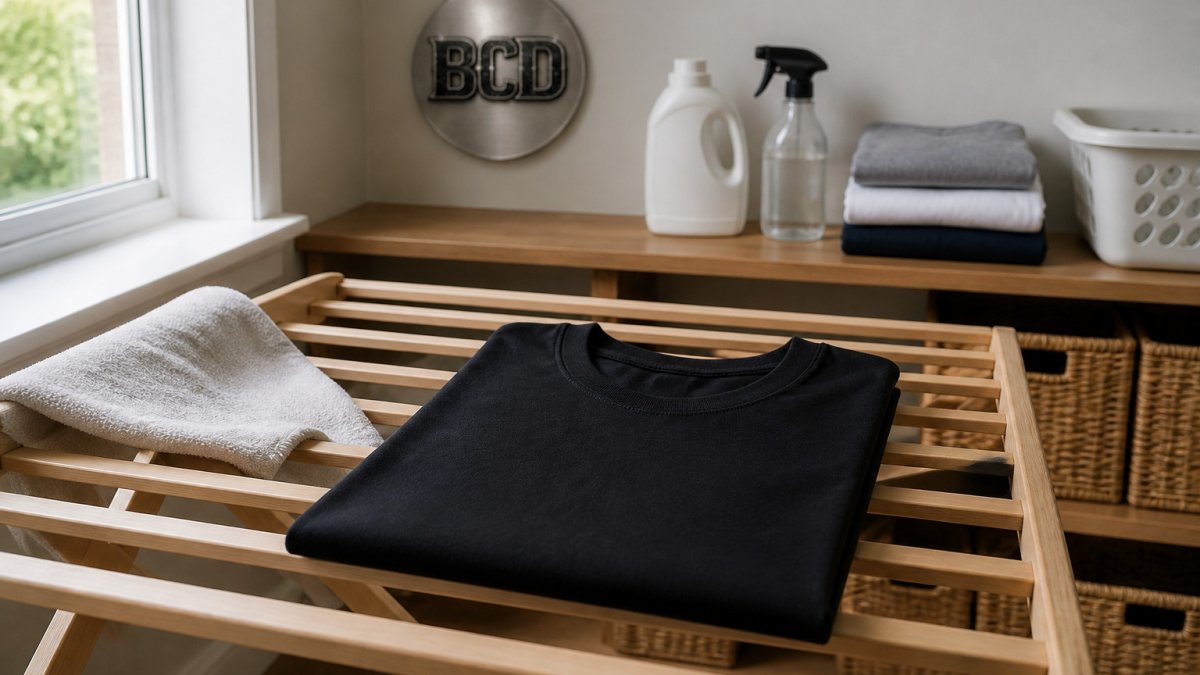
- Air dry if you can. Hang it or lay it flat. Takes longer, lasts longer.
- If you tumble dry, use low heat. Hot cycles crack prints and bake off color.
- Turn it inside out before drying, same as washing.
A black tee left to air dry on a rack will generally last longer than one put through a hot dryer.
Why T-Shirt Prints Crack or Peel
Cracking and peeling come from heat, stretch, and age. Heat softens the ink or vinyl. Stretching happens when you wring it out, toss it in the dryer wet, or wear a tight fit that pulls on the print.
Ink quality matters too. Cheap prints crack sooner. Good prints hold up for years with normal care. If a shirt is peeling after a handful of washes, the print was probably low quality or it got cooked somewhere along the way.
What to Do With a Tee That Has Already Faded or Peeled
Most advice stops at prevention. Here's a look at what you can and can't save once a shirt is already going.
Faded Color: What's Recoverable and What Isn't
Fading is dye loss. Once the dye is gone from the fiber, it's gone. No detergent, vinegar soak, or color-restoring product puts it back the way it was. What you can do is stop it from getting worse and, in some cases, even out the look.
- Dark shirts that have gone gray or patchy: A cold-water soak with a color-safe detergent can lift residue that's dulling the surface, which sometimes brings back a little depth. It won't restore the original black.
- Even fading across the whole shirt: This is normal wear. A shirt that's faded evenly usually still looks fine, it's the patchy, blotchy fading from residue or sun exposure that looks bad.
- Sun fading: UV does real damage. If a shirt lives on a dashboard or a clothesline in direct sun, rotate it or dry it in shade. You can't undo UV damage.
Peeling Vinyl and Cracking Prints
Peeling is an adhesion failure. The vinyl has let go of the fabric. You can slow it down, but you can't re-bond it at home without a heat press and the right settings, and a household iron usually makes it worse by smearing the adhesive.
- Trim, don't pull. Loose edges will catch in the wash and take more with them. Sharp scissors, small snips, follow the edge. Don't tug.
- Stop washing it. A peeling shirt that gets washed weekly will be gone in a month. Spot-clean it, air it out, wear it less.
- Cracking without peeling: The print is still attached but the ink layer has fractured along fold lines. Cold water and air drying will keep it from spreading. There's no fix for the cracks themselves.
Stains on a Printed Shirt
Stain treatment is where people wreck prints. The rule is simple: treat the stain, not the print.
- Check the care label first. It tells you what the blank can handle.
- Blot, don't scrub. Scrubbing drives the stain into the fibers and abrades the print.
- Apply mild detergent to the stain, not the print. Work it in from the back of the fabric if you can.
When to Call It
A shirt is done when the print is cracked across most of the design, peeling in multiple spots, or faded to the point where you can't read it. At that stage, no routine brings it back. Demote it to a work shirt, a garage shirt, or a rag. Wearing it around the house is fine, just don't expect it to survive another twenty washes.
The honest answer on fading: you can slow it and prevent it, but you can't fully reverse it.
Set Your Wash Routine and Expect Realistic Wear
Cold water, a gentle cycle, and air drying help a graphic tee hold its color. Expect some softening over the years. That's normal wear, not a bad shirt.
Here's a simple routine:
- Wash inside out, cold water, gentle cycle
- Mild detergent, no bleach
- Air dry or low heat only
Following that routine helps the print hold up. Skipping it usually means the print wears out sooner.
If you're picking out a new shirt, check the fit before you buy. Our size guide on how to choose the right T-shirt size is worth a look. And if you're wondering whether graphic tees fit your work life, see our breakdown on whether graphic tees are appropriate for work. For tees built for daily wear, take a look at our review of durable graphic tees for daily wear.
Frequently Asked Questions
Do graphic tees fade quickly?
They can, but it depends mostly on how you wash and dry them. Heat from a hot wash or a hot dryer breaks down the ink and the cotton fibers under it, and that is where most fading starts. A tee washed inside out in cold water, on a gentle cycle, and hung to dry will usually keep its color far longer than one tossed in hot with towels. Dark shirts show fading the fastest, so they need the most care.
Does vinegar stop black clothes from fading?
Vinegar is a mild acid that can help set dye in some fabrics, but it will not stop fading on its own. Adding a half cup to a cold rinse may help keep dark colors from washing out, but it does nothing for heat damage or friction. Pair it with cold water, inside-out washing, and air drying for the best results. Check the care label before using it on any printed shirt.
How do you fix a cracked graphic tee?
You cannot really repair a cracked print. Once the ink has broken down, it will keep flaking. The best move is to stop the damage from spreading by washing the shirt inside out in cold water and air drying it. If the print is badly cracked, the shirt is usually done, so replace it and change how you wash the next one.
